Pages

Showing posts with label chemistry. Show all posts

Hydrogen sulfide could be next anti-ageing agent


Hydrogen sulfide (H2S) may play a wide-ranging role in staving off ageing, says a research team from China who has explored the compound’s plethora of potential anti-ageing pathways.
H2S has been gaining increasing attention as an important endogenous signaling molecule because of its significant effects on the cardiovascular and nervous systems, the team noted.
The evidence is mounting, they said, that hydrogen sulfide slows ageing by inhibiting free-radical reactions, by activating SIRT1, an enzyme believed to be a regulator of lifespan, and probably through its interactions with a gene, klotho, which appears to have its own market basket of anti-ageing activity.
Hydrogen sulfide is produced within the human body, and has a variety of important physiological effects. For example, it relaxes the vascular endothelium and smooth muscle cells, which is important to maintaining clean arteries as one ages, explained first author Zhi-Sheng Jiang, of the University of South China, Hunan.

It functions as an antioxidant. And it inhibits expression of pro-inflammatory factors, all of which “imply an important role in ageing and age-associated diseases,” according to the study.
For example, mice lacking CSE, the gene for an enzyme involved in producing H2S, manifest extensive, premature arteriosclerosis, an inevitable consequence of ageing, said Jiang.
The gene, klotho, which appears to be upregulated by hydrogen sulfide, is thought to extend lifespan via a number of different pathways, some of which promote production of endogenous antioxidants, according to the their report.

Produced in the kidneys, it has direct angiotensin-converting enzyme (ACE) inhibiting activity; that is, it’s an ACE inhibitor, just like certain drugs that mitigate high blood pressure. Not surprisingly, plasma H2S declines with age, and is lower in spontaneously hypertensive rats than in those with normal blood pressure. More generally, a lack of H2S is implicated in cardiovascular disease.
A decline in H2S is also thought to undermine neurological health. Endogenous H2S has been found wanting in an animal model of Parkinson’s disease, and is found to be depressed in the brains of patients with Alzheimer’s disease. There are even suggestions, mostly in animal models, but also in human studies, that H2S may be protective against cancer, according to the report.
“Data available so far strongly suggest that H2S may become the next potent agent for preventing and ameliorating the symptoms of ageing and age-associated diseases,” concluded Jiang.
In the future, he asserted, people may take H2S via food, or as an anti-ageing supplement.
The results appeared online ahead of print in the journal Molecular and Cellular Biology.

Americans Win Nobel in Chemistry for Work on How Humans Sense the World

Two Americans shared this year’s Nobel Prize in Chemistry for deciphering the communication system that the human body uses to sense the outside world and send messages to cells — for example, speeding the heart when danger approaches. The understanding is aiding the development of new drugs.

The winners, Dr. Robert J. Lefkowitz, 69, a professor at Duke University Medical Center in Durham, N.C., and a Howard Hughes Medical Institute researcher, and Dr. Brian K. Kobilka, 57, a professor at the Stanford University School of Medicine in California, will split eight million Swedish kronor, or about $1.2 million

.

New cavity-filling material reverses decay and regenerates tooth structure

A new composite material, which is made up of silver and calcium nanoparticles, could work as a dental filling that kills remaining bacteria so that patients don’t have to make a return trip to the dentist.
Dental fillings replace the part of the tooth drilled out inorder to remove decay. But if any bacteria remains, the cavity can grow right under the filling, Discovery News reported.
The new material, developed by researchers at theUniversity of Maryland, also rebuilds any structure affected by decay, essentially getting rid of the cavity altogether.

Due to their small size, the silver nanoparticles can invade the cellular structure of bacteria and other microorganisms and kill them. Calcium phosphate, also included in the composite, is responsible for building the tooth back up.
There have been questions raised about implementing these materials into toothpaste or mouthwash, but the scientific community isn’t ready to get on board with that just yet.
There is a lot of concern coming from scientists and researchers about the possible harmful affects of human consumption of the particles. Further testing will be conducted on volunteers to sort through the health concerns. 


Garlic can acts as stronger antibiotics for food-borne illness


Researchers have isolated a compound in garlic that is a 100 times more potent than popular antibiotics in combating Campylobacter bacteria, one of the commonest causes of intestinal illness. Some 2.4 million Americans alone are affected by Campylobacter every year, according to the Centers for Disease Control and Prevention, with symptoms including diarrhoea, cramping, abdominal pain and fever.
Garlic

"This work is very exciting to me because it shows that this compound (diallyl sulphide) has the potential to reduce disease-causing bacteria in the environment and in our food supply," says Xiaonan Lu, postdoctoral researcher at the Washington State University, who led the study.
Lu and colleagues looked at the ability of the garlic compound, diallyl sulphide, to kill the bacteria when it is protected by a slimy biofilm that makes it 1,000 times more resistant to antibiotics, the Journal of Antimicrobial Chemotherapy reports.
 They found the compound can easily penetrate the protective biofilm and kill bacterial cells by combining with a sulphur-containing enzyme, changing the enzyme's function and effectively shutting down cell metabolism, according to a Washington statement.
Diallyl Sulphide 


The researchers found that diallyl sulphide was as much as 100 times effective than much of the antibiotics erythromycin and ciprofloxacin and would often work in a fraction of the time.
"This is the first step in developing or thinking about new intervention strategies. Campylobacter is simply the most common bacterial cause of food-borne illness in the United States and probably the world," says Michael Konkel, study co-author who has been researching Campylobacter jejuni for 25 years.
Previously, Lu and colleagues found that diallyl sulphide effectively kills important foodborne pathogens, such as listeria monocytogenes and Escherichia coli O157:H7.

New method can make even muddy water safe for drinking


A scientist at Michigan Technological Universityhas developed a simple, cheap way to make water safe to drink, even if it's muddy. It's easy enough to purify clear water. The solar water disinfection method, or SODIS, calls for leaving a transparent plastic bottle of clear water out in the sun for six hours.
That allows heat and ultraviolet radiation to wipe out most pathogens that cause diarrhea, a malady that kills 4,000 children a day in Africa.
It's a different story if the water is murky, as it often is where people must fetch water from rivers, streams and boreholes.

 'In the developing world, many people don't have access to clear water, and it's very hard to get rid of the suspended clay particles,' said Joshua Pearce, an associate professor of materials science and engineering.
'But if you don't, SODIS doesn't work. The microorganisms hide under the clay and avoid the UV,' he explained.
Thus, to purify your water, you first have to get the clay to settle out, a process called flocculation.
Working with student Brittney Dawney of Queen's University in Ontario, Pearce discovered that one of the most abundant minerals on Earth does this job very well: sodium chloride, or simple table salt.
 Salt is inexpensive and available almost everywhere. And it doesn't take very much to make muddy water clear again.
 'The water has a lower sodium concentration than Gatorade,' Pearce said.
 This would still be too much salt to pass muster as American tap water, but American tap water is not the alternative.
 'I've drunk this water myself. If I were somewhere with no clean water and had kids with diarrhea, and this could save their lives, I'd use this, no question,' he added.
Salt works best when the suspended particles are a type of clay called bentonite. The technique doesn't work as well with other kinds of clay.
However, by adding a little bentonite with the salt to water containing these different clays, most of the particles glom together and settle out, creating water clear enough for SODIS treatment.
Pearce and Dawney are running more tests on water containing various types of clays, and they are also investigating different soil types across Africa to see where their methods might work the best.
Their paper has been accepted for publication in the Journal of Water, Sanitation, and Hygiene for Development and will appear in June. 

New semiconductor synthesized from graphene


Scientists and engineers at the University of Wisconsin-Milwaukee have discovered a completely new carbon-based material, synthesized from graphene, which could mark a big step towards faster electronics. While transistors based on graphene are widely expected to take over from current devices, they're expensive to mass-produce. Another problem is that, until now, graphene-related materials existed only as conductors or insulators.
"A major drive in the graphene research community is to make the material semiconducting so it can be used in electronic applications," says professor of mechanical engineering Junhong Chen. "Our major contribution in this study was achieved through a chemical modification of graphene."
The new material, graphene monoxide or GMO, will be easier to scale up than graphene, says the team. And, like silicon, it's semiconducting, so that electrical current can be controlled.
"Now all three characteristics of electrical conductivity - conducting, insulating and semiconducting - are found in the carbon family, offering needed compatibility for use in future electronics," says the team.

The team created GMO by accident, while conducting research into the behavior of a hybrid nanomaterial consisting of carbon nanotubes and tin oxide nanoparticles.
In one experiment, they heated graphene oxide in a vacuum to reduce oxygen. Instead of being destroyed, however, the carbon and oxygen atoms in the layers of GO became aligned, transforming themselves into the 'ordered', semiconducting GMO - a carbon oxide that doesn't exist in nature. At different high temperatures, the team actually produced four new versions of the material.
Because GMO is formed in single sheets, the team says the material could have applications in products that involve surface catalysis. The scientists are now exploring its use in the anode parts of lithium-ion batteries, hoping to make them more efficient.

Scientists capture first image of two atoms vibrating INSIDE a molecule


A new photograph shows two atoms vibrating together inside a molecule - a first for science.
Researchers used a mind-boggling technique where they turned an electron into a 'flash bulb' to capture the image. 
The precise control required to set off the 'flash' has offered hope that scientists may one day be able to control chemicals at the atomic scale.
The team used ultrafast laser pulses to knock one electron out of its natural orbit in a molecule. 
When it returns to the molecule, the atoms have moved - allowing the scientists to capture the atoms in motion. 
Principal investigator Louis DiMauro of Ohio State Universitysaid that the feat marks a first step toward not only observing chemical reactions, but also controlling them on an atomic scale.
‘Through these experiments, we realized that we can control the trajectory of the electron when it comes back to the molecule, by adjusting the laser that launches it,’ said DiMauro, who is a professor of physics at Ohio State.
‘The next step will be to see if we can steer the electron in just the right way to actually control a chemical reaction.’

A standard technique for imaging a still object involves shooting the object with an electron beam – bombarding it with millions of electrons per second. The researchers' new single-electron quantum approach allowed them to image rapid molecular motion. 
‘You could use this to study individual atoms,’ DiMauro added, ‘but the greater impact to science will come when we can study reactions between more complex molecules. Looking at two atoms – that's a long way from studying a more interesting molecule like a protein.’

Chemically modified graphene could lead to flexible electronics


Researchers have come a step closer in creating faster, thinner, flexible electronics with the development of a new method for chemically altering graphene.
Highly desired for its many promising attributes, graphene is a one-atom thick, honeycomb-shaped lattice of carbon atoms with exceptional strength and conductivity.

Among graphene's many possible applications is electronics: Many experts believe it could rival silicon, transforming integrated circuits and leading to ultra-fast computers, cellphones and related portable electronic devices.

But first, researchers must learn how to tune the electronic properties of graphene -- not an easy feat, given a major challenge intrinsic to the material.
Graphene


Unlike semiconductors such as silicon, pure graphene is a zero band-gap material, making it difficult to electrically "turn off" the flow of current through it. Therefore, pristine graphene is not appropriate for the digital circuitry that comprises the vast majority of integrated circuits.

To overcome this problem and make graphene more functional, researchers around the world are investigating methods for chemically altering the material. The most prevalent strategy is the "Hummers method," a process developed in the 1940s that oxidizes graphene, but that method relies upon harsh acids that irreversibly damage the fabric of the graphene lattice.

Researchers at Northwestern University's McCormick School of Engineering and Applied Science have recently developed a new method to oxidize graphene without the collateral damage encountered in the Hummers method.

Their oxidation process is also reversible, which enables further tunability over the resulting properties of their chemically modified graphene.

"Performing chemical reactions on graphene is very difficult," said Mark C. Hersam, professor of materials science and engineering at the McCormick School.

"Typically, researchers employ aggressive acidic conditions, such as those utilized in the Hummers method, that damage the lattice and result in a material that is difficult to control.

"In our method, however, the resulting graphene oxide is chemically homogeneous and reversible — leading to well-controlled properties that can likely be exploited in high-performance applications," said Hersam, who is also a professor of chemistry and of medicine.

To create the graphene oxide, researchers leaked oxygen gas (O2) into an ultra-high vacuum chamber. Inside, a hot tungsten filament was heated to 1500 degrees Celsius, causing the oxygen molecules to dissociate into atomic oxygen. The highly reactive oxygen atoms then uniformly inserted into the graphene lattice.

The resulting material possesses a high degree of chemical homogeneity. Spectroscopic measurements show that the electronic properties of the graphene vary as a function of oxygen coverage, suggesting that this approach can tune the properties of graphene-based devices.

"It's unclear if this work will impact real-world applications overnight. But it appears to be a step in the right direction," Hersam said.

Next, researchers will explore other means of chemically modifying graphene to develop a wider variety of materials, much like scientists did for plastics in the last century.

The finding will be published Feb. 19 in the journal Nature Chemistry. 


New Particle was discovered that could help to cool Earth


Scientists have discovered a particle that could "cool the planet" and naturally clean up the atmosphere.
According to researchers from The University of Manchester, The University of Bristol and Sandia National Laboratories, Criegee biradicals are invisible chemical intermediates and are powerful oxidisers of pollutants such as nitrogen dioxide and sulfur dioxide, produced by combustion.
Although these chemical intermediates were hypothesised in the 1950s, it is only now that they have been detected. Scientists now believe that, with further research, these species could play a major role in off-setting climate change.
The detection of the Criegee biradical and measurement of how fast it reacts was made possible by a unique apparatus, designed by Sandia researchers, that uses light from a third-generation synchrotron facility, at the Lawrence Berkeley National Laboratory's Advanced Light Source.


Earth
The intense, tunable light from the synchrotron allowed researchers to discern the formation and removal of different isomeric species – molecules that contain the same atoms but arranged in different combinations.

The researchers found that the Criegee biradicals react more rapidly than first thought and will accelerate the formation of sulphate and nitrate in the atmosphere. These compounds will lead to aerosol formation and ultimately to cloud formation with the potential to cool the planet.

Carl Percival, Reader in Atmospheric Chemistry at The University of Manchester and one of the authors of the paper, believes there could be significant research possibilities arising from the discovery of the Criegee biradicals.

"Criegee radicals have been impossible to measure until this work carried out at the Advanced Light Source. We have been able to quantify how fast Criegee radicals react for the first time," Percival said.

"Our results will have a significant impact on our understanding of the oxidising capacity of the atmosphere and have wide ranging implications for pollution and climate change.

Evolution of Green house gases
"The main source of these Criegee biradicals does not depend on sunlight and so these processes take place throughout the day and night," he added.

The study has been published in Science.

Bat Plant shows cancer-fighting potential!!


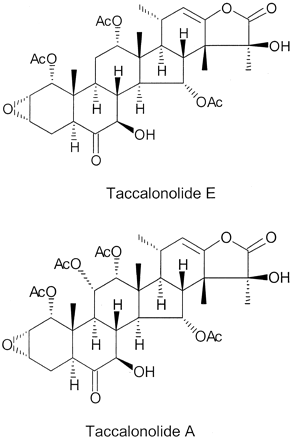
Bat plant, or Tacca chantrieri, could be used to fight cancer, according to researchers with The University of Texas Health Science Center at San Antonio.
The researchers have pinpointed the cancer-fighting potential in the plant.
Susan Mooberry, Ph.D., leader of the Experimental Development Therapeutics Program at the Cancer Therapy and ResearchCenter and a professor of pharmacology in the School of Medicine at the UT Health Science Center, has been working to isolate substances in the plant, looking for a plant-derived cancer drug with the potential of Taxol.

Taxol, the first microtubule stabilizer derived from the Yew family, has been an effective chemotherapy drug, but patients eventually develop problems with resistance over time and toxicity at higher doses.
So, researchers have long been seeking alternatives.
“We’ve been working with these for years with some good results, but never with the potency of Taxol,” said Dr. Mooberry, lead author of the study.
“Now we have that potency, and we also show for the first time the taccalonolides’ cellular binding site,” she stated.

Microtubules are structures in the cells that act as conveyer belts. They help maintain cell shape and help guide chromosones in cell division to ensure that every new cell, including every new cancer cell, gets a full complement of genetic material.
When microtubules are stabilized — essentially held still so they can’t do their jobs — this disrupts numerous cellular processes, and the cell can die.
The taccalonolides stabilize microtubules in cancer cells, but they do not attack healthy cells, Dr. Mooberry said.
“We’ve run normal prostate cells and normal breast cells through these tests, and they don’t die. The taccalonolides selectively kill cancer cells,” she noted.
The study was published this month in the Journal of the American Chemical Society.


Modern Periodic table gains two new elements!!!


Two new elements have been officially added to the periodic table - twelve years after they were first discovered.
With the atomic numbers 114 and 116, they have the temporary titles of ununquadium and ununhexium. Now they've been offically recognized, their discoverers have the opportunity to give them permanent names.
They're likely to be named flerovium, after the Soviet nuclear physicist Georgy Flyorov, and moscovium, after the Russian capital.
Both elements were created at the Joint Institute for Nuclear Research in Dubna, near Moscow, in collaboration with the Lawrence Livermore national laboratory in California. In the past, the two organizations have had some disagreement about naming new, jointly-discovered elements, but it seems this time the Californians are being a little more laid-back.
The new elements aren't exactly kicking about the place; both are heavy elements created in a particle accelerator by smashing together ther nuclei of other elements. Thus, 114 was created by combining calcium with plutonium, and 116 by combining calcium and curium.
They're both highly radioactive, decaying in well under a second - making studying their properties rather difficult.
The last element to be added to the periodic table was copernicium, approved in 2009.
And, as it happens, three more may soon be joining the party. Scientists also believe they've found the elements representing positions elements 113, 115, and 118 in the periodic table.
But governing bodies the International Union of Pure and Applied Chemistry (IUPAC) and the International Union of Pure and Applied Physics (IUPAP) say these don't yet reach the criteria neccessary for acceptance.

Spongy carbon an energy storage breakthrough!!!


According to TG Daily Scientific efforts to create new high performance, efficient energy storage technologiesmay be taking a pretty big leap forward according to researchers at The University of Texas.


The research team, led by Professor Rodney S. Ruoff, has created a new porous, three-dimensional carbon they say can be used like a "greatly enhanced supercapacitor."
In a statement, the team likens a supercapacitor to a sprinter. It can discharge a bunch of energy very quickly, but also runs out of energy quickly because of its limited storage potential.
Comparatively, a battery is more like a marathon runner which can store a lot more energy but, because of the way batteries store energy, they are slower to discharge it. 


The team believes that the continuous, three-dimensional porous network that is created within their new sponge-like carbon is an optimum electrode material for supercapacitors because, apparently, it is an excellent conductor of electricity and the massive amount of surface area it offers within a very small space will allow supercapacitors to store much more energy. 


To put this new carbon’s attributes into perspective, Professor Ruoff explains that just one gram of the material contains 3,100 square meters of surface area. Two grams of the material have roughly as much surface area as a football field.
Eric Stach, a material’s scientist at the U.S. Department of Energy’s Brookhaven National Laboratory and co-author of a paper about the material that will be published in Science magazines online publication, believes the enhanced storage capacity combined with a supercapacitor’s existing attributes of rapid discharge and lengthy life-cycle make this new form of carbon "particularly attractive for meeting electrical energy storage needs that also require a quick release of energy - for instance, in electric vehicles or to smooth out power availability from intermittent energy sources, such as wind and solar power."

Professor Ruoff says the process used to make the material is readily scalable to industrial levels, which would suggest the new carbon can be quickly implemented into new energy storage devices which are used in everything from energy grids to electric cars and even consumer electronics.

Team finds simple way to split hydrogen from water


According to TG Daily it seems possible to generate energy from water by splliting hydrogen from water.Splitting water to create renewable energy could be simpler than previously thought, says an international team led by Australia's Monash University.
Using sunlight to create a cheap, efficient way to split water would open up production of hydrogen as a clean fuel. And professor Leone Spiccia says the key to the hydrogen economy could come from a very simple mineral, commonly seen as a black stain on rocks.
"The hardest part about turning water into fuel is splitting water into hydrogen and oxygen, but the team at Monash seems to have uncovered the process, developing a water-splitting cell based on a manganese-based catalyst," says Spiccia.
"Birnessite, it turns out, is what does the work. Like other elements in the middle of the Periodic Table, manganese can exist in a number of what chemists call oxidation states. These correspond to the number of oxygen atoms with which a metal atom could be combined."
When an electrical voltage is applied to the water-splitting cell, it splits water into hydrogen and oxygen. And, after the catalyst was examined at work using advanced spectroscopic methods, the team found that it had decomposed into a much simpler material called birnessite - well-known to geologists as a black stain on many rocks.
The catalyst appears to mimic nature's biogeochemicalical cycling of manganese in the oceans.
"This may provide important insights into the evolution of Nature’s water splitting catalyst found in all plants which uses manganese centres," says coauthor Dr Rosalie Hocking of the Australian Centre for Electromaterials Science.
"Scientists have put huge efforts into making very complicated manganese molecules to copy plants, but it turns out that they convert to a very common material found in the Earth, a material sufficiently robust to survive tough use."

Share

Twitter Delicious Facebook Digg Stumbleupon Favorites More