Pages

Electricity generated from harmless viruses (Watch Video)

Scientists including one of an Indian origin have made a breakthrough that could lead to tiny devices that harvest electrical energy from the vibrations of everyday tasks such as shutting a door or climbing stairs. Berkeley Lab scientists have found a way to make harmless viruses harvest mechanical energy, which could then be used, say, to charge a phone as its owner walks along. They've created a generator that produces enough current to operate a small liquid-crystal display. It harvests energy when the user taps a finger on a postage stamp-sized electrode coated with specially engineered viruses which convert the force of the tap into an electric charge.
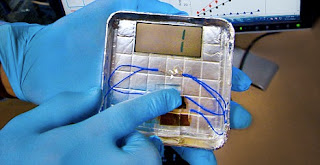

The generator is the first to produce electricity by harnessing the piezoelectric properties of a biological material. It could replace the use of highly-toxic chemicals in current piezoelectric devices.
It could also lead to a simpler way to make microelectronic devices, as the viruses self-assemble into an orderly film.
"More research is needed, but our work is a promising first step toward the development of personal power generators, actuators for use in nano-devices, and other devices based on viral electronics," says Seung-Wuk of Berkeley Lab and UC Berkeley.
The M13 bacteriophage only attacks bacteria and is benign to people. It replicates itself by the millions within hours, so there's always a steady supply, and it's easy to genetically engineer.
When pressure is applied to the generator, it produces up to six nanoamperes of current and 400 millivolts of potential - about a quarter the voltage of a triple A battery.
"We're now working on ways to improve on this proof-of-principle demonstration," says Lee. "Because the tools of biotechnology enable large-scale production of genetically modified viruses, piezoelectric materials based on viruses could offer a simple route to novel microelectronics in the future."
Watch Video

Now, Google brings instant answers to search results


Google will now give instant answers to your queries right on its search results page. The Internet search giant has built up an 'encyclopedia' of 200 million people, places and products, and will deliver that information through Search.

For example, type in 'Mona Lisa', and a biography appears right on the page (on the right hand side), type in 'Leonardo DiCaprio' and you get a list of the Titanic star's films, and suggested related searches.

 According to The Daily Mail, Google, and the Microsoft-ran competitor Bing, have both previously answered results in the Search Engine Results Page (SERP) before, such as when searching for 'weather' or for football results.
But this is the most graphical and fully-fledged attempt by Google yet to place answers on the search engine, the report said.
Google has quietly collected information on 200 million 'entities' - people, places, products.
The new version of search will feed users information about the 'entity' they are searching for. 

New cavity-filling material reverses decay and regenerates tooth structure

A new composite material, which is made up of silver and calcium nanoparticles, could work as a dental filling that kills remaining bacteria so that patients don’t have to make a return trip to the dentist.
Dental fillings replace the part of the tooth drilled out inorder to remove decay. But if any bacteria remains, the cavity can grow right under the filling, Discovery News reported.
The new material, developed by researchers at theUniversity of Maryland, also rebuilds any structure affected by decay, essentially getting rid of the cavity altogether.

Due to their small size, the silver nanoparticles can invade the cellular structure of bacteria and other microorganisms and kill them. Calcium phosphate, also included in the composite, is responsible for building the tooth back up.
There have been questions raised about implementing these materials into toothpaste or mouthwash, but the scientific community isn’t ready to get on board with that just yet.
There is a lot of concern coming from scientists and researchers about the possible harmful affects of human consumption of the particles. Further testing will be conducted on volunteers to sort through the health concerns. 


'Twitter will last longer & become more valuable than Facebook', says Ad.expert


Micro blogging site Twitter is expected to last longer and become more valuable than social networking giant Facebook, one of the UK's leading ad men has claimed. Ad firm Ogilvy and Mather's vice-chairman Rory Sutherland, who helped to turn Microsoft into a major consumer brand in the Eighties, said although Facebook might be the most popular social network at the moment, it could struggle to maintain that position in the future.
"I can see Facebook being superseded more easily than Twitter being superseded," The Telegraph quoted Sutherland, as saying.
Facebook Vs Twitter 

 "As a forum for outbursts, Twitter's [character] limit, its haiku element is very appealing. I wouldn't bet against it being more valuable [than Facebook] in the long term," he added.

Sutherland's remarks come as Facebook is gearing up for the largest initial public offering the technology sector has ever seen.

Twitter is growing rapidly in metropolitan areas, but has struggled to make money out of advertising.

Sutherland, however, believes that Twitter's 'potential for making money is higher than anyone realises'.What do our Readers think please post your Comments

New wireless battery chargers to be Reality soon for all Devices


As Samsung allies with other big tech firms to make the wireless charger widespread, wireless battery charger is possible for other electronic device as well. One of the biggest surprises at Samsung's Galaxy S3 launch last week was a charger that powered the smartphone wirelessly - but now it seems that the technology could soon be widespread.
Samsung, Qualcomm and other tech companies have joined forces to establish a single standard to allow devices to charge wirelessly - using a technology similar to the one in electric toothbrushes today.
Samsung Galaxy SIII

One single charger will 'beam' power to several devices at once - and the chargers could even work in cars.
A single standard could also mean that the new wireless era isn't plagued with the problem of 'finding the right cable' - one wireless technology should (hopefully) work for all. 
Wireless technology leaders Samsung and Qualcomm Incorporated have joined other technology leaders to form the Alliancefor Wireless Power (A4WP), it was announced today.
The A4WP will focus on a new wireless power transfer technology that provides spatial freedom for charging of electrical devices in cars, on tabletops and for multiple devices simultaneously.

Benefits of this wireless power approach include: a transmitter and receiver antenna design that is easily implemented, a simple wireless power control system, and the ability to transfer power through non-metallic surfaces. 
A single specification is envisioned that will address simultaneous charging of multiple devices ranging from very low power products, such as Bluetooth headsets, to today’s most sophisticated tablets.
Jason dePreaux, a research manager at IMS Research comments, ‘Wireless power has the potential to increase convenience and improve the user experience in consumer devices like mobile phones by untethering the charging process.
'For these benefits to be realized, wireless power infrastructure must be deployed to enable wireless charge points in the home, at work, or while traveling without concern for compatibility. Industry alliances will play a critical role in developing this infrastructure.’ 

Share

Twitter Delicious Facebook Digg Stumbleupon Favorites More